
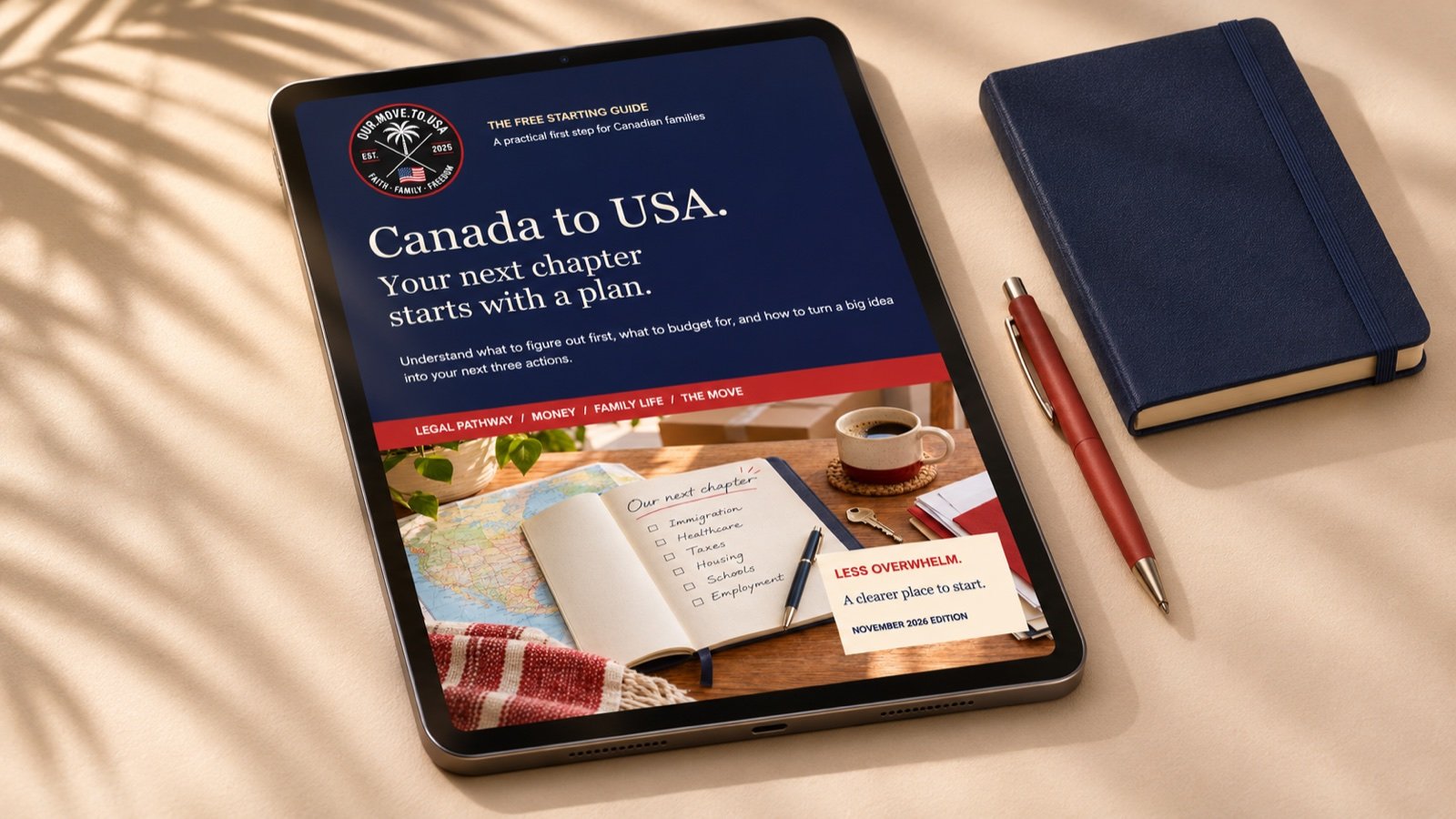
Our Free Canada to USA Moving Guide Is Here: Why We Created It
NEW · THE FREE STARTING GUIDE · NOVEMBER 2026
The idea of moving to America can feel exciting long before it feels organized. You can picture the next chapter, but the practical questions arrive all at once: immigration, money, housing, healthcare, schools, and what has to happen first.
We’ve released a free Canada to USA moving guide to give those questions a place to start. It is the resource we wish we’d had at the beginning: a clear overview, useful planning pages, and a way to turn “we’re thinking about it” into a few informed actions.
Meet your starting point
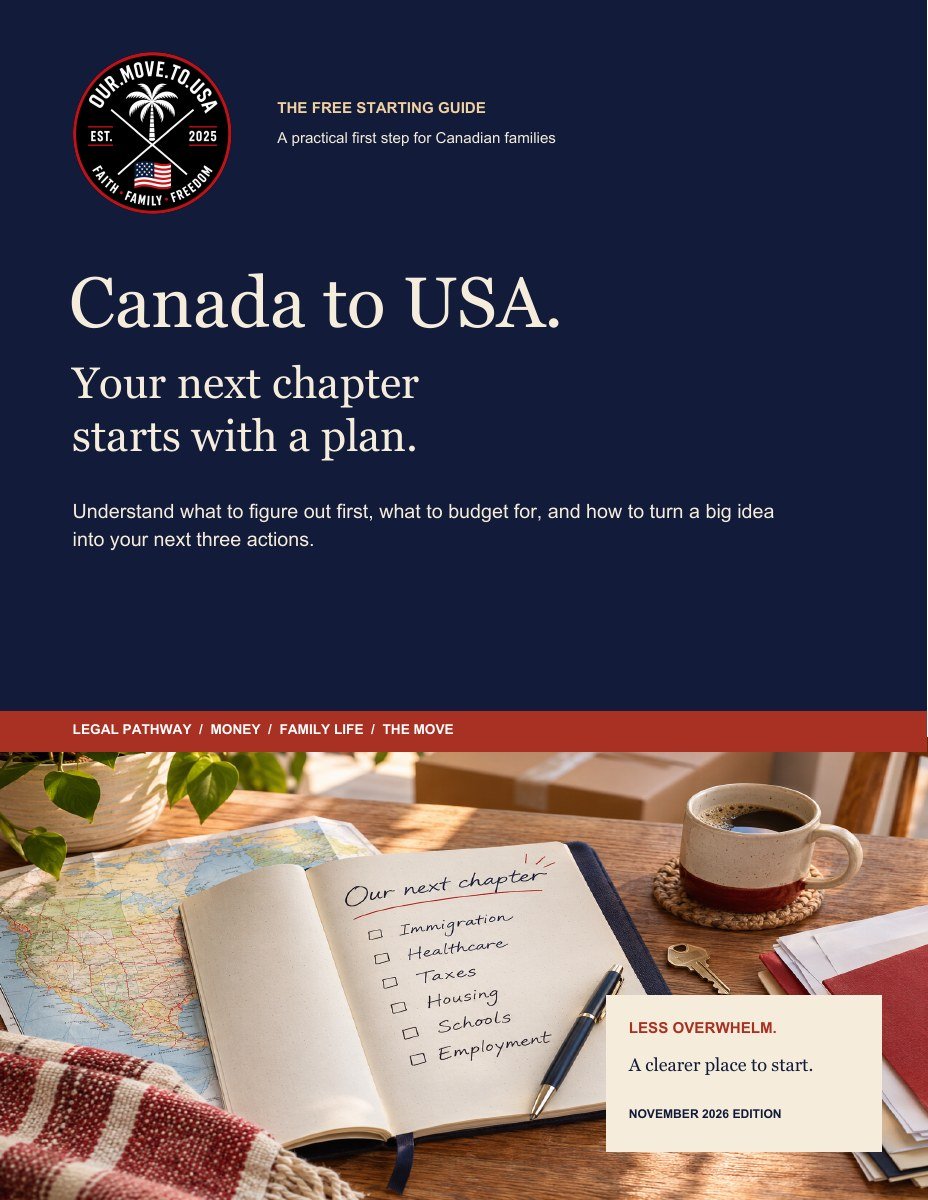
Canada to USA: Your Starting Guide is a free 16-page PDF for Canadian families exploring a legal move to the United States. Inside: a planning roadmap, household budget, document checklist, and your next three actions.
Inside this article
Why we made the guide free
We created this guide for two reasons: to give Canadians a practical starting point, and to make the resource we wish we’d had when we started asking our own questions. There is a lot to learn before a move becomes a workable plan. Having somewhere sensible to begin should be easy.
At the beginning, it is tempting to research everything at once. Homes in Florida. Immigration categories. Health insurance. School districts. Currency transfers. Every answer seems to create three more questions. The problem is often the order of the research: a house budget depends on income, income depends on work permission, and the move date depends on the legal process.
A starting guide cannot decide those things for a family. It can put them on the same page, in a useful order, and help someone identify the next question that matters. That is the job we built this one to do.
Making it free lets you look at the planning questions before deciding what your own move might involve. There is no payment or account needed. You request it with your first name and email, and the download link appears after the form is submitted.
We’re sharing from the middle of our own move
We’re Adam and Jen, a family of five preparing to move from Ontario to Central Florida. We have a clear direction, but we are still doing the work required to get there. Our family story explains how years of conversations became a decision.
As of publication, Jen’s I-130 is still pending. Adam filed it in December 2025 as her U.S. citizen sponsor. NVC processing has not started, the Montreal interview is not scheduled, and we do not have a confirmed move date. A guide launch does not change any of that.
What it does reflect is the kind of preparation we believe is useful while the process unfolds: understanding the questions, keeping the paperwork organized, looking at the household budget, and researching ordinary life in the place we hope to call home.
Our experience gives the guide its family perspective. It does not establish your eligibility, predict your processing time, or turn our choices into rules for everyone else. We want you to leave with better questions for your own circumstances.
What’s inside the 16-page guide
The guide is called Canada to USA: Your Starting Guide. The November 2026 edition is a 16-page PDF designed to be read once for the big picture and returned to while you build your plan.
It follows five connected areas: the legal pathway, family finances, daily life, moving logistics, and the next actions you can actually take. Those areas overlap in real life, so the guide brings the questions together rather than treating each one as an isolated project.
You will find a household budget worksheet, a document checklist, planning prompts for before departure and after arrival, and a page for choosing your next three actions. The final pages link to official resources, so there is a clear route from an introductory explanation to the agency responsible for the rules.
It is a starting tool rather than an application manual. The aim is to help you organize the unknowns, replace assumptions with evidence, and understand which decisions need individual professional advice.
Start with the legal route, then build the rest around it
Pages 4–5 put the legal and family questions first. Who is moving? What citizenship or status does each person already have? Which route might fit the facts? Who could work, and when? What documents would be needed?
A Canadian passport alone does not give someone general permission to relocate permanently or work in the United States. A family connection, employment opportunity, or business idea is a reason to investigate the relevant category; it is not a result. The State Department’s Canadian travel guidance is one useful official starting point.
The guide also asks readers to think about everyone in the household. An answer for the lead applicant may leave important questions open for a spouse or child. Work permission, school plans, renewals, and changes in employment need to be considered in the context of the specific route.
Use these pages to prepare a one-page family summary and a focused consultation question list. Our immigration resource collection connects to official information for further research.
Put the whole move in the budget
The worksheet on page 6 separates monthly U.S. household spending from one-time transition cash. That distinction matters. A monthly budget can look manageable while deposits, temporary accommodation, transport, and overlapping expenses create pressure before the household is settled.
The monthly categories cover housing and utilities, healthcare, vehicles, food, children’s costs, debt, savings, and other commitments. The transition side includes application and professional fees, travel, movers, deposits, setup costs, currency conversion, and the income gap.
The worksheet asks you to use U.S. dollars for the U.S. plan and to convert Canadian funds using the rate and fees you can actually obtain. It also leaves room for a reserve based on your household’s circumstances. It does not prescribe a universal minimum amount everyone should save.
A useful first pass can contain estimates. The next pass should identify which estimate most needs a real quote. If healthcare or housing could change the decision, start there. Our article about the financial thinking behind our move explains why we look at the entire household equation.
Give tax and banking an early place in the plan
Page 7 brings the Canadian and U.S. sides together. It prompts readers to prepare an inventory of accounts, assets, income, business interests, and proposed dates before talking with a cross-border tax professional.
The CRA’s guidance for people leaving Canada explains residential ties and possible departure-tax issues. U.S. tax questions depend on the person’s circumstances too. A simple day-count shortcut cannot answer every question for both countries.
The banking prompts are practical: what documents will a bank need, how will funds move, what are the total transfer costs, and how will the family access money during the transition? The guide also encourages readers to ask how landlords or lenders assess newcomers rather than assume a Canadian credit history transfers automatically.
These are questions to resolve before major asset or account decisions. The guide helps you prepare for that conversation; it does not tell you to sell a particular investment, close a registered plan, or change ownership.
Plan for ordinary days in the place you choose
Pages 8–9 look at location and healthcare. A destination can be exciting while still requiring careful research into the everyday routine. Where will work, school, shopping, care, and community fit around the address?
For our family, Central Florida is the destination we are working toward. We want the sunshine and outdoor life, but we also need to understand insurance, storm exposure, summer routines, driving distances, and the actual cost of a home. Our Florida story shares the personal side of that choice.
For schools, the guide points you toward direct confirmation with the district about the address, enrollment requirements, records, placement, and support. For healthcare, it asks about eligibility, effective dates, family enrollment, networks, prescriptions, and the costs beyond the premium.
HealthCare.gov identifies moving from abroad as a possible Special Enrollment Period trigger. Eligibility and actual coverage dates still need confirmation. The practical goal is to know what protects the family and when, rather than discover the gap after arrival.
Decide what crosses the border—and what stays with you
Pages 10–13 cover belongings, vehicles, documents, departure planning, and the first month. This is where an idea becomes a set of coordinated tasks: an inventory, a written quote, a folder of records, and the essentials you need without opening a truck.
For belongings, the guide encourages a room-by-room decision and clear questions about packing, storage, delivery windows, coverage, and customs responsibility. A vehicle needs separate research into permanent import, safety and emissions compliance, ownership or lender consent, paperwork, costs, and state registration.
The document checklist on page 11 groups records by identity, immigration, family, work, money, and the move. It also reminds readers to keep secure backups and accessible originals. The exact required documents still come from the instructions relevant to the person, process, and destination.
For timing, the guide uses milestones rather than an invented countdown. Exploring a move, making major commitments, confirming the move, and preparing for the final week are different stages. After arrival, the priorities shift to work, care, school, transport, payment access, and a stable routine.
How we suggest using the guide
First, read it from beginning to end without trying to solve every question. Mark the areas that are already clear and the ones where you are relying on an assumption. That gives the research a shape.
Second, use page 6 for a rough budget and page 11 for the document inventory. Add the facts you know, label the estimates, and write down where confirmation needs to come from. A quote from a provider, an answer from a district, and advice from a qualified professional serve different purposes.
Third, turn to page 14. Choose three actions: confirm one legal question, replace one financial guess, and check one daily-life requirement. Give each action an owner and a target date. The examples are deliberately small enough to act on.
For example, a family might prepare an immigration consultation summary, request an actual health-plan cost, and confirm enrollment requirements for one shortlisted neighbourhood. Those actions will not complete a relocation, but they can remove three uncertainties that were holding the rest of the plan back.
Keep the guide beside your own notes and revisit it when a milestone changes. If you want the longer practical overview, our 12-point Canada-to-USA moving checklist takes the preparation further.
What the free guide can—and cannot—do
The guide can help you organize a move, understand the main workstreams, and prepare more useful questions. It can give a partner or family member a shared overview so the conversation is about the same plan.
It cannot decide immigration eligibility, promise approval, predict an interview date, recommend a tax strategy for your assets, or select medical coverage for your family. Those are individual questions. Official rules, provider terms, and professional advice take priority over a general planning resource.
It also cannot make everyone’s move look like ours. A single professional moving for work may have different priorities from a family of five. Someone with established U.S. citizenship, complex medical needs, a Canadian business, or a different destination will need to adapt the questions.
That is why the guide includes official links and clearly describes its purpose. We want it to be useful because it is realistic about its role. The November 2026 edition is a starting point that readers should check against current requirements before acting.
A few practical questions before you download
Is this only for people moving to Florida? No. Our family’s destination gives the guide its perspective, but the main questions cover a Canada-to-USA move. Readers considering another state can use the structure and substitute their own location, school, insurance, licensing, and tax research. Local requirements need checking wherever you plan to live.
Can I use it before choosing an immigration route? Yes. Start with the legal-pathway pages and write down what needs confirmation. You can research the broad budget and daily-life questions at the same time, while keeping major commitments tied to the route and its requirements. The guide does not assess eligibility.
Can my partner and I work through it together? Yes. The budget and action page are useful shared discussion tools. Agree which figures are confirmed, which are estimates, and who will follow up on each question. A shared plan is easier to review when both adults know what an assumption is based on.
Do I need to print all 16 pages? You can read the PDF on a screen and keep separate notes. If you prefer paper, start with the budget on page 6, document list on page 11, and action plan on page 14. Keep personal records in secure storage rather than writing sensitive identifiers onto a worksheet that may be left out.
Will this tell me exactly when we can leave? No. The planning sequence is based on milestones, and every legal process has its own requirements and uncertainty. Use confirmed instructions and dates for your case. A useful plan can still make progress while a move date remains unknown.
How to get your free copy
Go to the free-guide section on our Start Here page. Enter your first name and email address, then submit the request. The confirmation reveals the PDF download link on the page. Download and save your copy from there.
The guide is free. No payment or account is required. The current delivery flow displays the link after submission; you do not need to wait for an email to begin reading. We record the request details, as explained beside the form and in our Privacy Policy.
If you want ongoing updates, the website’s Insider List is a separate signup. You can also follow the Journal as we share the decisions, waiting, discoveries, and practical lessons from our own move.
We made this guide because a big decision becomes easier to work on when the next step is clear. Whether you are only curious or already researching a legal route, we hope it gives you the starting point we wished we had.
Published November 3, 2026. The guide shares general planning information and our family’s perspective. Confirm current legal, tax, financial, healthcare, and local requirements with official sources and qualified professionals.
Editorial review · November 3, 2026. Our family’s preparation is still in progress. Follow the linked official sources for current requirements and use advice that fits your circumstances.