
Moving From Canada to the USA Checklist: 12 Things We’re Doing Before We Leave
ONTARIO → FLORIDA · OUR PREPARATION IN PROGRESS
Moving countries becomes real in the details. A passport expiry date. A health-plan start date. The school records you need before the boxes leave. For our family, the dream of life in Florida now comes with a growing list of practical questions.
This is the moving from Canada to USA checklist we’re using to organize those questions. We’re still in Ontario, still going through the immigration process, and still preparing. Some tasks can move forward now; others depend on approvals and dates we do not have yet.
Canada has given our family roots, relationships, and a life we value. We’re looking toward America for the opportunity, lifestyle, and next chapter we want to build. Preparing carefully is how we give that decision a stronger foundation.
The order matters
Start with legal permission, a realistic budget, and healthcare timing. Research the rest in parallel, but keep major commitments tied to confirmed milestones. Your situation may be different.
Our Canada-to-USA moving checklist at a glance
New to the idea? Our Start Here roadmap gives you the broader picture. Our Resources hub brings practical explainers, official sources, and our family’s research together.
01 / Confirm the legal route for every family member
Our first question is permission: who can live in the United States, on what basis, and when? Canadian citizenship makes some kinds of travel easier. It does not create a general right to relocate permanently or take a U.S. job. The State Department’s guidance for Canadians explains the distinction between visa requirements and admission.
For our family, this is very real. Adam filed Jen’s I-130 in December 2025 as her U.S. citizen sponsor. As of this article, the petition is still pending; NVC processing has not started, the Montreal interview is not scheduled, and we do not have a confirmed move date. Our family story and immigration timeline show where we actually are.
We’re keeping the research moving while allowing the legal process to set the pace. Another family may be looking at employment, a professional category, or an investment route. Temporary status and permanent residence serve different purposes. A qualified U.S. immigration attorney can assess the route, dependent status, and travel questions for your facts.
Before leaving: confirm each person’s position, required evidence, and the milestone that makes relocation possible.
02 / Build a secure document folder
Five people means five sets of identity details, records, and practical questions. Our preparation needs a single secure home for those documents, with accessible originals for travel and protected digital copies as backup.
The working list includes passports, citizenship evidence, birth and marriage certificates, relevant name-change documents, immigration notices, school records, vaccination histories, medical summaries, insurance information, and recent financial records. Custody or travel-consent paperwork may also matter for some families. The exact immigration document list comes from the instructions for your case.
We’re separating documents we can gather now from documents that may need to be obtained close to a later appointment. Ordering something too early can be as unhelpful as ordering it too late if the relevant instructions impose a validity period. Names and dates also deserve a careful comparison across records.
Before leaving: identify missing records, check expiry dates, and keep travel-day originals with you rather than inside the moving truck.
03 / Price the transition and the monthly life separately
“Can we afford Florida?” is too broad to answer with a house listing. We need to understand both the cost of getting there and the cost of keeping our household running afterward. Our financial thinking behind the move explains why the full picture matters to us.
For transition cash, the categories include application and professional fees, travel, movers, storage, deposits, temporary accommodation, vehicle costs, utility setup, and any overlap with Canadian expenses. The monthly plan needs housing, healthcare, transport, food, school-related spending, debt, savings, and ordinary family life.
We’re using U.S. dollars for the destination budget and the exchange rate and fees we could actually obtain for Canadian funds. Then comes a stress test: what if income starts later, an insurance quote is higher, or the exchange rate moves against us? A reserve should reflect our household’s risks, rather than an arbitrary number from somebody else’s move.
Before leaving: replace the largest guesses with written quotes and give the income gap its own budget line.
04 / Get cross-border tax advice before moving assets
Tax planning belongs before the big transactions. Immigration status, citizenship, and tax residency are related parts of life, but they answer different questions. Crossing the border does not, by itself, settle every filing obligation.
The CRA’s leaving-Canada guidance explains residential ties and possible deemed dispositions of certain property. The IRS substantial presence test can count days across three calendar years, subject to exceptions. U.S. citizens also need advice that reflects their existing U.S. obligations.
Our preparation includes the questions to take to a cross-border professional: the home, investment accounts, registered plans, business interests, pensions, proposed dates, and records of time spent in each country. Accounts such as TFSAs, RESPs, and RRSPs deserve individual review; a familiar Canadian label does not answer every U.S. tax question.
Before leaving: bring an account-and-asset inventory to the adviser before selling, withdrawing, transferring ownership, or closing anything.
A useful planning tool
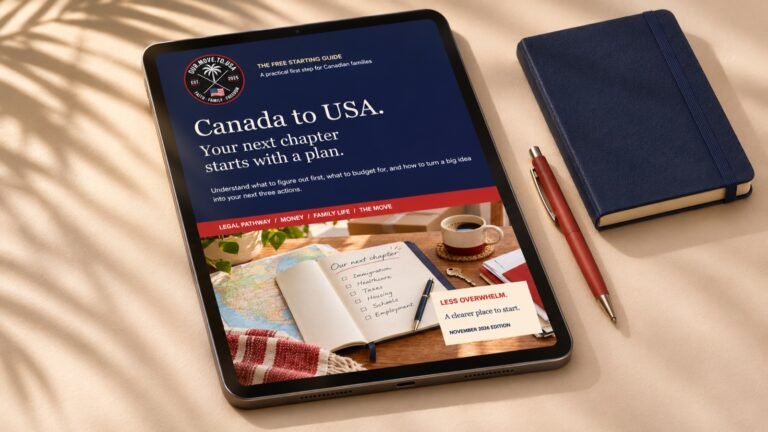
Our free 16-page starting guide includes a household budget, document checklist, and a page for your next three actions. Use it alongside this article to turn research into a working plan.
05 / Plan banking, currency transfers, and access to money
A Canadian account holding U.S. dollars and a U.S.-based bank account can solve different problems. We need to ask what will actually work for rent, payroll, bills, transfers, and everyday payments after arrival.
The practical questions are straightforward: which identity, address, and tax documents does the bank require? Can an account be opened before arrival, or only afterward? What happens to Canadian accounts when residency changes? How will we access money if a transfer is delayed or a card stops working?
We also want to compare the whole currency-transfer cost, including fees and the exchange-rate margin. For housing and borrowing, we’ll ask how providers assess newcomers rather than assume our Canadian credit record will appear automatically in a U.S. credit file. Income records and landlord references may be useful, but each provider sets its own screening requirements.
Before leaving: confirm the bank’s requirements, maintain reliable payment access during the transition, and avoid moving every available dollar in one untested step.
06 / Know exactly when healthcare coverage begins
Healthcare needs a date on the calendar, not a vague intention to buy insurance after arrival. Our aim is to understand what protects every family member from the day that protection is needed.
For an employer plan, that means asking about eligibility, dependent enrollment, waiting periods, premiums, and the effective date. For other options, it means checking eligibility and enrollment rules. HealthCare.gov lists a move from a foreign country as a possible Special Enrollment Period trigger; that does not make every household automatically eligible for every plan.
We’re looking beyond the premium to deductibles, copays, coinsurance, prescription coverage, provider networks, exclusions, and the out-of-pocket limit. We also need ServiceOntario to confirm how a permanent move affects OHIP. Temporary-absence provisions should not be treated as a promise of coverage after emigrating.
Before leaving: confirm coverage dates in writing and assess any gap policy against the actual family situation. Our healthcare resources provide a starting point for the research.
07 / Arrange the medical and prescription handover
Insurance is one piece of continuity of care. The other is making sure a new provider can understand the history without our family having to reconstruct it under pressure.
Our preparation list includes vaccination records, relevant test results, care summaries, dental information, and a medication list with generic names and dosages. We want to know the process and possible cost of obtaining records from our Canadian providers, and how long it can take.
For any medication, we need to confirm an appropriate supply with the prescriber, the applicable border rules, and how to arrange follow-up care in the United States. We cannot assume a Canadian prescription will simply be filled at a Florida pharmacy. Controlled medicines and other restricted products need especially careful checking with the relevant authorities.
Before leaving: request the records early, plan lawful medication access, and identify the kind of local care each family member may need. Keep essential medical information accessible during travel.
08 / Research a Florida address for everyday life
We’re preparing to move from Ontario to Florida because of the future we want to build there. Our reasons for choosing Florida go beyond a holiday. The housing research needs to do the same.
An address affects school options, commuting, access to healthcare, shopping, community, and how much time gets spent in the car. We want to compare actual neighbourhoods and realistic routines, including summer heat and storm preparation.
For renting, the questions include deposits, screening, accepted income evidence, lease terms, utilities, parking, and cancellation conditions. For buying, the wider picture includes property taxes, insurance quotes, flood exposure, HOA obligations, maintenance, and the timing of a purchase. A listing price cannot answer those on its own.
Before leaving: compare the total cost and daily routine around a small shortlist of addresses. Keep commitments aligned with the immigration timeline rather than assuming an approval date.

09 / Prepare school records and give the kids a voice
For our family of five, a good move has to work for the children as well as the adults. School preparation includes paperwork, but it also includes giving everyone room to ask questions about the change.
We need to verify district boundaries for any proposed address and contact the district about enrollment requirements. Topics to check include transcripts, vaccination documentation, placement, learning supports, calendars, transportation, and before- or after-school care. An estate listing or an online rating is not the final authority on school assignment.
There is also the less administrative side: keeping contact with friends, understanding the first school day, choosing familiar activities, and talking about what will stay the same. We can be excited about America while acknowledging that leaving familiar people and routines is a big change.
Before leaving: confirm requirements directly with the district and keep a separate question list for the children. Our school research resources can help start that conversation.
10 / Connect work and business plans to legal permission
Opportunity and entrepreneurship are part of our reason for moving. The practical task is to connect those ambitions to lawful work, realistic income, and the actual timing of the move.
Each adult needs their own answer about work authorization. A job offer, business registration, spouse’s status, or existing Canadian client does not by itself resolve the immigration question. Remote work also needs review in the context of the person’s status and activity.
Our research needs to cover professional licensing where relevant, employer onboarding, benefits, tax and payroll questions, and the household impact if one income starts later. For a business, the questions may include where work is performed, registrations, insurance, contracts, and professional advice on the structure.
Before leaving: confirm permission and start dates before counting income in the budget. Use our employment resources to identify the official route information, then get advice specific to the plan.
11 / Decide what to ship and investigate each vehicle
The moving quote starts with deciding what is worth bringing. We want a room-by-room inventory and a keep, sell, donate, or replace decision that reflects transport cost and usefulness in the new home.
Written mover quotes should spell out packing, storage, delivery windows, valuation or insurance arrangements, and customs responsibilities. CBP’s household-goods guidance explains inventory requirements and the use of Form 3299 for unaccompanied articles. Confirm the rules for the specific shipment, including restricted goods.
A vehicle needs its own calculation. Permanent import is different from a visit. Before deciding to bring one, confirm safety and emissions eligibility, ownership or lender consent, entry documents, applicable duties or fees, insurance, and destination-state registration requirements. The VIN and certification labels matter more than a general reassurance that Canadian cars are similar.
Before leaving: compare the full cost of shipping and importing with replacement. Keep essential documents, medications, chargers, clothes, and first-night supplies outside the shipment.
12 / Map the Canadian departure and first month in America
The final checklist needs both sides of the border. Canadian services and accounts have different notice periods, while arrival tasks depend on documents, housing, and legal status.
Our list includes mail forwarding, utilities, mobile service, insurance changes, subscriptions, records for tax advisers, and notifications to the appropriate institutions. We need to ask providers what changes when we leave Canada and coordinate end dates rather than cancel everything at once.
In Florida, the early plan should cover admission records as applicable, healthcare enrollment, banking, phone service, utilities, school arrangements, work onboarding, and Social Security steps appropriate to each person. We’ll check the current Florida new-resident instructions for driver licensing, vehicle title, registration, and insurance deadlines.
Before leaving: make a first-week plan, a first-month plan, and a backup contact list. Leave space for ordinary life too: groceries, a park, a familiar meal, and time to settle in.
Questions Canadians ask before the move
Can we move to America just because we are Canadian? Canadian citizenship alone does not give someone permanent residence or general work authorization. Research the route for each family member before arranging a permanent move.
How much money should we save? There is no useful universal figure. Add your actual transition costs, an income-gap reserve, and an emergency cushion to a realistic monthly budget. Housing, insurance, family size, and work timing can change the answer substantially.
Should we book movers while immigration is pending? Research and quotes can be useful now. A non-refundable booking creates a different commitment. Check cancellation terms and keep the decision tied to the confirmed requirements and timing of your case.
What should we do first?
Choose the biggest unanswered question in your own plan. If the legal route is unclear, start there. If that is established, replace one major cost estimate with a real quote or confirm the healthcare timing. One resolved uncertainty is more useful than twenty open browser tabs.
We’ll keep sharing what we learn as our family moves through the process. The checklist will keep developing with us. Follow the Journal for the next chapter, and use the free starting guide to give your own preparation a place to begin. Read why we created the free guide for a closer look inside.
Planning information reviewed November 3, 2026. This article shares our preparation and general research, not individualized immigration, legal, tax, financial, or medical advice. Confirm current requirements with official agencies and qualified professionals.
Editorial review · November 3, 2026. Our family’s preparation is still in progress. Follow the linked official sources for current requirements and use advice that fits your circumstances.